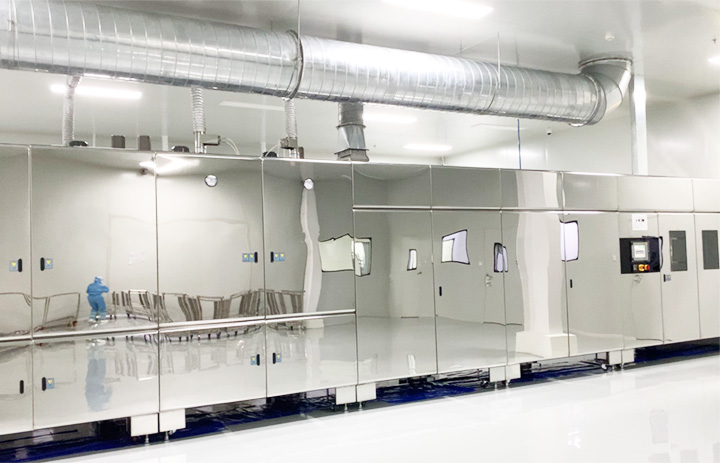
The production of inner pattern on PCB is a crucial step in electronic manufacturing, and its accuracy and quality have a significant impact on the stability and reliability of electronic products. In the production of inner pattern on boards, processes such as film lamination, exposure, development, and etching are indispensable. The first step is the film lamination process. Lamination is the first step in the production of inner pattern and also the fundamental process in the entire PCB production process. The purpose of pre-treatment coating is to form a protective layer on the copper foil covering layer to control the etching and chemical reactions of the copper foil on the board. The pre-treatment lamination process adopts the principle of photoinduced polymerization reaction, which starts after the photosensitive film absorbs ultraviolet light. By using professional equipment, the entire photosensitive film is evenly covered on the copper foil covering layer, and then subjected to ultraviolet radiation, the photosensitive film is polymerized on the copper foil under the excitation of ultraviolet radiation to form a protective layer. Next is the exposure process. The purpose of exposure is to transfer the circuit pattern and component pattern from the PCB design file to the photosensitive film of the PCB, forming a pattern. During the exposure process, it is necessary to use high-energy ultraviolet lamps and ultraviolet lenses to transfer the pattern of the light transmission line from the photosensitive film to the copper foil to make the pattern. Then there is the development process. Development refers to the removal of the protective layer of the photosensitive film on the entire PCB through chemical treatment, exposing the copper foil where the photosensitive film remains. Developing requires the use of chemical developer to chemically remove the protective layer of non circuit patterns, exposing the copper foil and forming circuit patterns. The etching process is the most important step in the production of PCB, with the aim of removing the protective layer and making the copper foil fully cover the circuit pattern. The etching process adopts the principle of chemical corrosion, which removes non line corrosion from the protective layer through acidic or alkaline chemical solutions, achieving separation between the line and non line. In this process, it is necessary to control the chemical solution to control the rate of chemical reaction and the temperature of the chemical solution, in order to ensure the accuracy and quality of the circuit pattern.