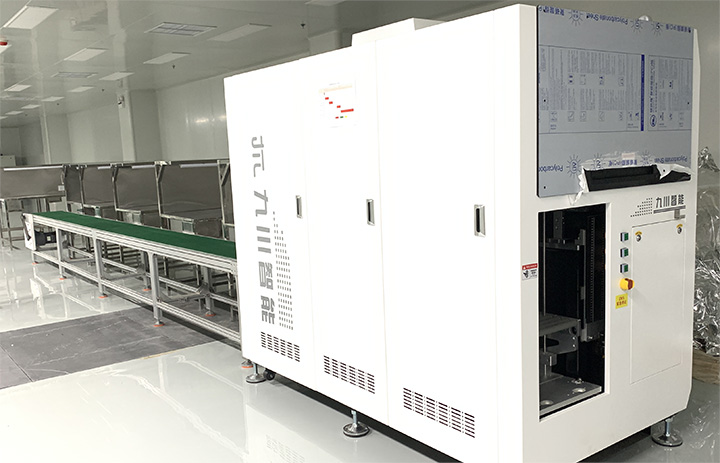
The hole checker is a device commonly used in the electronics manufacturing industry for the verification and detection of holes in PCB. Relying on advanced technology and high-precision control, these machines can achieve fast and accurate hole verification, providing an irreplaceable service for the electronics manufacturing industry. The principle of the hole checker is based on optical measurement. It uses high-precision optical sensors that are able to accurately measure the diameter and position of the hole, as well as detect and verify it. Before checking, you need to set the detection parameters, including the location and diameter of the hole to be checked. Automatic detection and data analysis can be realized through the control system. The hole checker machine of PCB has the characteristics of high efficiency, accuracy and stability, which can improve the production efficiency and quality of the PCB. The operation process of the hole checker machine is relatively simple. First of all, the PCB needs to be placed on the workbench and the appropriate detection parameters need to be set through the computer software. Next, the machine will automatically start scanning all the holes on the PCB and output the inspection results in the computer display. If any problems are found, they can be marked and located using computer software for subsequent repair. In the electronics manufacturing industry, defective PCB can have an adverse impact on the production process, especially for boards with high-speed transmission and precise control needs, the accuracy of the hole position is especially important. In this case, the machine quickly detects and validates potential hole defects, helping customers to confirm the quality of the entire electronics manufacturing process. Through CAD design, the machine can realize the verification of a variety of holes, and has high reliability in terms of detection accuracy. These machines are often equipped with highly sophisticated CAM systems that automatically offset and accurately handle many different hole types such as single points, blind holes, blind slots and cross holes. The hole inspection machine can also use equipment such as industrial cameras to monitor the entire process and reduce operational errors and human errors through automated control. Its advantage is that it can achieve high efficiency, high precision and high reliability processing, and it also has a variety of different detection modes and automatic control functions. In addition, the hole checker machine has a high degree of automation, simple operation, saving time and labor costs, and reducing the quality difference caused by human factors. !cross-section of blind hole Picture:cross-section of blind hole In the manufacture of PCB, the hole checker machine plays a vital role, which has a direct impact on the production quality of PCB. Through the machine, the accuracy, stability and reliability of the PCB can be ensured, and the circuit failure and other problems caused by improper hole processing of the PCB can be effectively avoided. Therefore, the use of board hole inspection machine can improve the quality and performance of pcb products, but also improve the competitiveness of enterprises and market share. The hole checker machine is one of the indispensable equipment in the electronic manufacturing industry. With them, electronics manufacturers can ensure that their electronic products meet high quality standards and increase production efficiency and compliance. In the future, with the wider application of technology and consumer demand for high-quality electronic products, the market demand for these machines is bound to continue to grow.